
Get here the summary, questions, answers, textbook solutions, extras, pdf of the story Dream Children: A Reverie by Charles Lamb of NBSE Class 11 Alternative English. However, the given notes/solutions should only be used for references and should be modified/changed according to needs.
Summary: The essay Dream Children: A Reverie begins by stating that children enjoy hearing stories about their elders as children because it allows them to imagine those elders whom they will never meet. Elia’s children huddle around him, listening to stories about their great-grandmother Field, who lived in a mansion that she looked after on behalf of a wealthy family who lived in a different mansion. Elia recalls that rich person removing a detailed wood carving portraying the story of the Children in the Wood to replace it with an ugly marble thing, which makes young Alice laugh.
Everyone praised Field’s goodness and religious faith at her funeral. According to Elia, she could recite Psalms and parts of the New Testament from memory. She was a fantastic dancer until she was diagnosed with cancer, but even then, she maintained her cheerful demeanour. She was convinced that two infant ghosts haunted her home, but she didn’t consider them dangerous, so it didn’t bother her too much. Even though he never saw them, the young Elia was terrified of them and needed help falling asleep every night.
The young Elia used to wander the grounds of that mansion, admiring all of the marble busts and fantasising about becoming one himself. He spent his days picking various fruits from the estate’s grounds. Elia takes a break from his recollection to observe his children, John and Alice, splitting a plate of grapes.
Field adored all of her grandchildren, but especially Elia’s elder brother John L___., a handsome and lively young man who grew up riding horses. When Elia became lame on his feet, John used to carry him around on his back. When John became ill, Elia felt he couldn’t care for his brother as well as John could, and when John died, Elia was reserved in emotion but consumed by grief. At this point in the story, Elia’s children begin to cry, requesting to hear about their dead mother rather than their uncle.
So Elia begins by telling them about his seven-year courtship of their mother Alice, complete with difficulties and rejection. But when he goes to see his daughter Alice, she has vanished. Elia is told by a disembodied voice that they are not Alice’s children, that the real father of Alice’s children is a man named Bartrum, and that they are only dreams. With that, Elia awakens in his armchair, his sister Bridget by his side, and John L____ is gone for good.

A. Answer the following questions briefly.
1. What kind of stories do children like listening to?
Answer: Children enjoy hearing stories about their elders that allow them to imagine a great-uncle or grand-mother whom they have never met.
2. What kind of a woman was Mrs Field?
Answer: Mrs Field was a good and religious woman who was well-liked and respected by all. She was such a good and religious woman that she knew all the Psalms and a large portion of the Bible by heart. She was also tall, straight, and elegant. Even the cruel disease that bowed her down in pain couldn’t break her spirits, which remained firm.
4. Who was John L ____? Why did Mrs Field love him in an ‘especial manner’?
Answer: The author’s elder brother was John L ___.
Mrs Field adored him in a “special” way because he was smarter than her other children. He was a brave, handsome, and spirited young man who reigned over his family like a king.
5. How did the author court the fair Alice?
Answer: For seven long years, the author courted the fair Alice, sometimes in hope, sometimes in desperation, but he never gave up.
C. Answer the following questions in detail.
1. Why is the story subtitled ‘A reverie’?
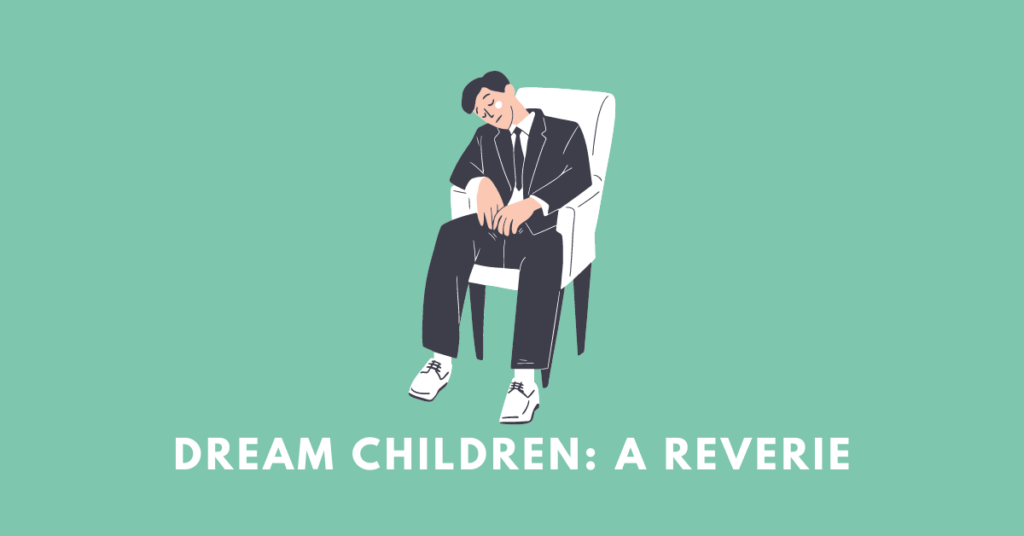
Answer: Lamb never married and thus never had children, so the story Dream Children is subtitled ‘A Reverie.’ He conjured up an imaginary picture of a happy conjugal life, which eventually disintegrates into nothing as he returns to reality. Charles Lamb is depicted as a recliner lost in a beautiful reverie, recalling some of his fond memories of his grandmother, Mrs Field. In his sweet reverie, he tells the children the story of his great grandmother. He responds to their questions, and they eventually vanish as he awakens from his dream. In fact, the subtitle ‘A reverie,’ which literally means a daydream or a fantasy, is a foreshadowing of the pathos of the return to reality, despite the fact that the essay (Dream Children: A Reverie) begins on a deceptively realistic note.
2. What kind of a relationship did the author and John share?
Answer: According to the author, John L ____ was a kingly figure. He admired him for his bravery and charisma. John L ____ had a soft spot for the author. He used to transport the author on his back. Many a mile he couldn’t walk for pain when he was a lame-footed boy. In fact, he was afraid of John L ____ when he was impatient or in pain. He had no idea how much he loved his brother until he died, and he missed him all day, missed his kindness and crossness, and wished he could see him again.
5. Critically analyse the line, ‘We are only what might have been, and must wait upon the tedious shores of Lethe millions of ages before we have existence.
Answer: This line from Dream Children: A Reverie reveals Charles Lamb’s philosophical observation about life. His belief that life is a dream is reflected in his dream, which relieves his memories and allows him to tell stories about his deceased loved ones. He sees no distinction between the modes of life in the past and the modes of life in the present. The dream implies that it will take millions of years for man to be able to target anything at all. It will be there once we have a name and an existence. The twist occurs near the end of the essay. The speaker’s children, John and Alice, turn out to be figments of his imagination. The essay Dream Children: A Reverie is especially successful because the realisation that it has all been a dream does not occur until the very end. The reader becomes engrossed in the speaker’s story, believing it to be true. The twist ending reveals that it was all a dream.
Additional/extra questions and answers/solutions
1. Create a character ketch for Lamb’s grandmother.
Answer: Lamb’s grandmother worked as a housekeeper at the grand mansion in Norfolk. Lamb was influenced by his grandmother as a child. She was a good and religious lady who was well-liked and admired by all. She had a great spirit, which enabled her to care for the great house in the most dignified manner until her death. She was often referred to as the mistress of the great house, despite the fact that she was only a caretaker there. She adored all of her grandchildren and frequently invited them to spend their vacations in her magnificent home. In her youth, she was regarded as the best dancer. Everyone assumed she knew the Psalter and the Testament by heart. When she died, people travelled long distances to attend her funeral.
2. What kind of person was John L____? Lamb admired him in what ways?
Answer: Charles Lamb’s elder brother was John L ___. Grandmother Field adored him the most. He was a charming and vivacious young man. Who despised being confined within the confines of the great house or the garden. He enjoyed trying new things. He used to ride the most stalwart horse into the countryside. He enjoyed running races with the hunters in the woods. Charles admired his elder brother and declared that he was the king to the rest of the children; he was especially concerned about his younger brother. When Charles was a child and became a lame footed boy, he carried him for miles on his shoulders. The author had a close relationship with his elder brother.
3. What similarities do Alice the mother and Alice the daughter share?
Answer: In his reverie, Charles Lamb sees his dream children, John and Alice. Alice, his dream daughter, was a spitting image of her mother. There are numerous parallels between Alice the daughter and Alice the mother mentioned in Dream Children: A Reverie. The daughter, like her mother, had a tender expression on her face. The writer compares the daughter’s eyes and bright hair to those of her mother. He couldn’t tell the difference in their eyes. It appeared to him as if Alice the mother was peering through Alice the daughter’s eyes. Alice the daughter, he thought, was the reincarnation (rebirth) of Alice the mother.
6. Who among the lamb brothers did grandmother Field prefer, and why?
Answer: According to the author, grandmother Field was very kind and loved all of her grandchildren, but one in particular she adored. Most notably, John ____. It was because he was a handsome and vivacious young man. He didn’t spend his time wandering around the lone house or the garden, but he did enjoy some adventures, such as horseback riding or running a race with the hunters. To the other children, he was a king. Everyone admired him for his selflessness and bravery, but his grandmother adored and admired him the most.
7. Why does Lamb say that grandmother Field was not the owner of the house yet in some ways she might be said to be the mister of it as well?
Answer: Mrs Field was the caretaker of the great house in Norfolk. She took exceptional care of the great house, even after the royal family relocated to a newer and more fashionable residence. She looked after it as if it belonged to her. She was devoted to her duties and upheld the dignity of the household until her death. Many people admired her dedication and loyalty. Despite the fact that she was not the true mistress of the house, she was referred to as such.

Ron’e Dutta is a journalist, teacher, aspiring novelist, and blogger. He manages Online Free Notes and reads Victorian literature. His favourite book is Wuthering Heights by Emily Bronte and he hopes to travel the world. Get in touch with him by sending him a friend request.
Get notes of other boards, classes, and subjects